
Extinguishing agents · TRIDENT
TRIDENT concentrate
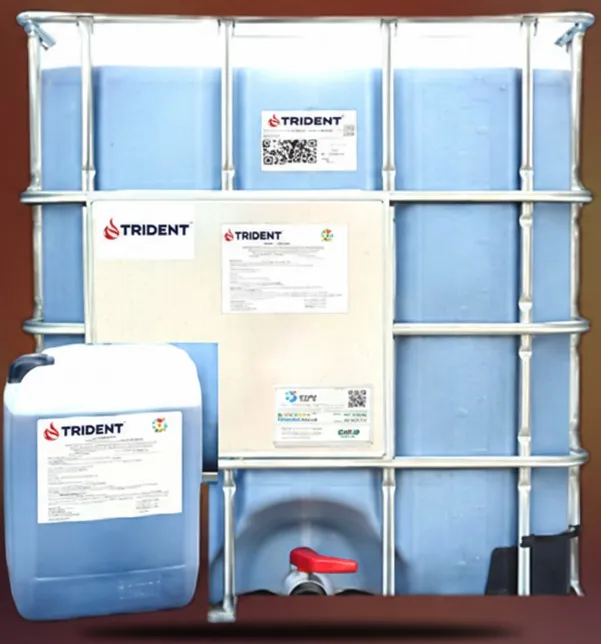
A new generation of environmentally friendly extinguishing agent, developed for fire services and police. A product in its own right rather than a copy of conventional foams, and free of fluorine compounds.
Key benefits
- Not classified as hazardous; no hazard labelling required under the EU CLP regulation (EC 1272/2008).
- Readily biodegradable: 95.6% in 28 days (OECD 301 F), with low aquatic toxicity (fish LC50 1,600 mg/l).
- Low induction rates: from 0.20% for Class A, and 3% for Class B as tested.
- Works with standard firefighting equipment with no special equipment, per manufacturer data.
- Fully miscible with water; not irritating to skin or eyes (OECD 404 and 405).
- Tested with simulated sea water under EN 1568-3.
Technical specifications
| Manufacturer | CW Fire-Support GmbH — Germany |
|---|---|
| Mixing ratio — Class A | 0.20% – 1% |
| Mixing ratio — Class B | 3% (as tested to EN 1568-3 and ICAO Level B) |
| Standard | EN 1568-3:2018 |
| Appearance | Amber liquid with a faint odour |
| Extinguishing performance / burn-back | III D with simulated fresh water and simulated sea water, at 3% |
| Civil aviation | ICAO Level B |
| pH | 7.56 at 20 °C (MPA Dresden test report 20230717-1); the safety data sheet states 7.3 |
| Surface tension | 27.6 mN/m for the 3% solution (measured by MPA Dresden) |
| Density at 20 °C | 1.064 g/cm³ (measured by MPA Dresden); safety data sheet estimate 1.01–1.05 |
| Water solubility at 20 °C | Complete |
| Water hazard class | WGK 1 |
| Freezing point | −5 °C (MPA Dresden declaration of conformity) |
| Storage | Preferably between 10 °C and 50 °C; not below −10 °C and not above 70 °C |
| Suitable containers | Low-density polyethylene or stainless steel |
| Shelf life | 10 years in the sealed original container |
| Packaging | IBCs approved to UN approval 31HA1/Y, and canisters |
Applications
- Class A — solids
- Wood, paper, coal, peat, rubber and plastics, hay, straw and grain, passenger vehicles.
- Class B — flammable liquids
- Jet A1 aviation fuel (ICAO Level B test) and water-immiscible liquids within the scope of EN 1568-3, such as petrol and kerosene. The published tests do not cover polar solvents.
Product suitability for each application is confirmed after a technical review with our team.
Test results
MPA Dresden — EN 1568-3:2018
Declaration of conformity KB 123/23 and test report 20230717-1: test fire performance III D at 3% concentration, with simulated fresh water and sea water.
MPA Dresden — ICAO Level B
Declaration of conformity KB 124/23 and test report 20230717-2: the concentrate meets the requirements of performance level B in the Airport Services Manual.
Hygiene Institute of the Ruhr Area — ecotoxicology
Biodegradation 95.6% after 28 days; fish LC50 1,600 mg/l; not irritating to skin or eyes; fluoro-organic compounds below the limit of detection.
View full document — Hygiene Institute of the Ruhr Area — ecotoxicology
ALS Environmental — PFAS analysis
Certificate of analysis ES2315684: all PFAS compounds tested were below the reporting limit.
Hygiene Institute — forest fires
No objection to using a 0.2% solution on forest fires within the dosage limit stated in the assessment.
Manufacturing and quality control
- The IBC is inspected inside and out for contamination and damage.
- Water and the raw materials are filled into the IBC by percentage using a calibrated scale.
- An IBC agitator mixes the water with the raw materials for two minutes.
- A 100 ml sample is taken into a vial before the IBC is sealed.
- The IBC is closed with a lead seal; the seal number and manufacturing date are recorded on the sample vial.
- The sample is tested by measuring pH and checking density.
- After passing quality control, the sample is kept by the manufacturer for 10 years.
- The IBC is ready for sale.
- All raw materials arrive with a certificate of analysis and a type 3.1 acceptance certificate to EN 10204.
- Each new batch carries its own number on the label.
- Per the manufacturer statement of 2 September 2026: 70 metric tons of concentrate in stock, and production capacity of about 20 metric tons per day.
Certifications
- EN 1568-3:2018Product: TRIDENT concentrate
- Foam concentrates for liquid fires — MPA Dresden — declaration of conformity KB 123/23 and test report 20230717-1 — 14 November 2023
- ICAO Level BProduct: TRIDENT concentrate
- Civil aviation performance level — MPA Dresden — declaration of conformity KB 124/23 and test report 20230717-2 — 14 November 2023
- ISO 9001:2015Manufacturer: CW Fire-Support GmbH
- Quality management system — Certificate 0973C2025 — CERTIS — issued 14 November 2025, valid until 13 November 2028, subject to annual surveillance
- Fluorine AnalysisProduct: TRIDENT concentrate
- Fluorine and PFAS analysis — ALS Environmental Sydney — ES2315684 — 17 May 2023
- Environmental ToxicityProduct: TRIDENT concentrate
- Environmental toxicity assessment — Hygiene Institute of the Ruhr Area — A-298272-18-Bi — 28 May 2018
- Forest Fire UseProduct: TRIDENT concentrate
- Use on forest fires — Hygiene Institute of the Ruhr Area — A-324878-20-Bi — 25 February 2020
- Made in GermanyManufacturer: CW Fire-Support GmbH
- Country of origin — MPA Dresden declarations of conformity (14 November 2023) — manufacturer statement (2 September 2026)
The manufacturer certificate belongs to CW Fire-Support GmbH; the declarations of conformity and reports belong to the product. Diverse Fleet holds none of them in its own name and presents them as exclusive agent.
Downloads
Original documents from the manufacturer and test laboratories, shown in full. The technical data sheet (TDS) is sent on request.
- Safety data sheet (SDS)CW Fire-Support GmbH · Last revised 8 November 2023
- Manufacturing and quality control statementCW Fire-Support GmbH · 2 September 2026
- EN 1568-3:2018 declaration of conformity and test reportMPA Dresden GmbH · 14 November 2023
- ICAO Level B declaration of conformity and test reportMPA Dresden GmbH · 14 November 2023
- PFAS certificate of analysisALS Environmental, Sydney · 17 May 2023
- Summary of ecotoxicological and occupational-medicine evaluationHygiene-Institut des Ruhrgebiets · 28 May 2018
- Ecotoxicological assessment for use on forest firesHygiene-Institut des Ruhrgebiets · 25 February 2020
- ISO 9001:2015 certificateCERTIS · Issued 14 November 2025 — valid until 13 November 2028
Field test videos
TRIDENT concentrate
Request a quotation for this product
State the quantity and application and we will reply with a written quotation. You can also request a field demonstration or qualification documents.